
Investors added more than Rs 10.56 lakh crore to their wealth as markets continued their rally for the sixth straight session on Thursday. The BSE Sensex went past 61,000-mark for the first time ever on Thursday. It jumped 568.90 points or 0.94 per cent to its new closing peak of 61,305.95.

'We expect the bull-market phase to still persist, but now led by large-caps which offer better valuation and benefit from FII inflows.'
'We expect continued pressure on midcaps, but any sharp correction looks unlikely from here on.'

The 30-share Sensex ended up 11 points at 25,561 and the 50-share Nifty gained 16 points to end at 7,640 levels.

Omkeshwar Singh, Head, Rank MF, a mutual fund investment platform, answers your queries.
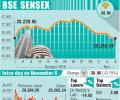
The 30-share Sensex ended down 39 points at 26,265.

Omkeshwar Singh, Head, Rank MF, a mutual fund investment platform, answers your queries.

The slowdown in corporate revenue growth over the last one year has begun to reflect in India Inc's capital expenditure, or capex. The country's top listed companies are going slow on fresh investment in capacity expansion, in line with a deceleration in their top line growth. The combined fixed assets of the listed companies, excluding banking, finance services and insurance (BFSI) and the government-owned oil & gas firms, were up 10.1 per cent year-on-year (Y-o-Y) during April-September 2023 (H1FY24) - the slowest in 18 months - as against 21.1 per cent Y-o-Y growth in H2FY23 (October 2022-March 2023) and 11.6 per cent growth in the April-September 2022 period (H1FY23).

rediffGURU and financial planning expert Colonel Sanjeev Govila will answer your personal finance-related questions.

The category average return of mid-and-small-cap funds is 95 per cent.
This NFO does not offer anything new and investors would be well advised to monitor its performance for 3 years before investing.

We asked colleagues, present and past, to reflect on a man who has made such a difference to their lives and careers. Here it is then, a rich collection of memories that offer enchanting glimpses of the enigmatic Ajit Balakrishnan.

Omkeshwar Singh, Head, Rank MF, a mutual fund investment platform, answers your queries.

'It really doesn't matter that investors getting allotments sell their IPO stock holdings on listing day because a new set of investors are entering.' 'This explains the continued rise in stock prices even after the first day of listing.'

'If the Congress loses this time, Rahul Gandhi will not look back at Amethi ever again.'

Long-term investors should not reduce or stop their equity mutual funds through SIPs.

"While the risk of a correction goes up in the near term, on a long-term basis the Indian market is on an absolutely strong footing."

NTPC was the top gainer in the Sensex pack, rallying around 4 per cent, followed by Titan, SBI, HUL, IndusInd Bank and UltraTech Cement. NSE Nifty advanced 63.15 points to 15,746.50.

Tata Consultancy Services (TCS), the group's biggest cash generator, overtook Vedanta to become the highest dividend payer in India in FY23. The IT services major paid Rs 42,090 crore for FY23, up 167.4 per cent from Rs 15,738 crore for FY22. The 10 biggest payers together shelled out Rs 2.06 trillion for FY23, more than double the Rs 98,371 crore for FY22.

PowerGrid was the top gainer in the Sensex pack, rallying over 4 per cent, followed by NTPC, UltraTech Cement, Tech Mahindra, Reliance Industries and IndusInd Bank.

'I think some of us, like Mukesh Ambani, myself and those of us who head industrial units, ought to really focus on what we can really do to make the world a safer place, maybe 50 or 100 years from now.' 'For instance, how can we deal with climate change and global warming, right now?' 'The effects of it may not be felt now; in fact, we may pay a price for it today, but it will help the generations to follow.'

Over half, or 269 NSE 500 stocks, have given over 10-fold (10x) returns in the last two decades, finds a recent report by Goldman Sachs that analysed 10 major markets across emerging and developed markets (EM/DM) that covered 6,700 stocks. The report examined '10-baggers' - stocks that have generated at least 10x total returns within a rolling 5-year period over the past two decades. Some of the prominent ones that comprise these 269 stocks in the Indian context stocks that delivered over 10x total returns over a 5-year rolling period since 2000 as per Goldman Sachs includes Westlife Foodworld, Bharti Airtel, Adani Total Gas, Patanjali Foods, Larsen & Toubro, BEML, Blue Star, Shree Cement, Lupin, Godrej Industries, Astral, Adani Enterprises, Hindustan Petroleum and Deepak Fertilisers.

The 30-share Sensex ended down 181 points at 26,657.

ONGC was the top gainer in the Sensex pack, rallying around 6 per cent, followed by IndusInd Bank, L&T, UltraTech Cement, Titan, SBI and NTPC. NSE Nifty settled 32.10 points up at 14,707.80.

'Sell in May, go away' is a popular market adage. But 'Don't sell any new shares in May' is the best kept secret of Dalal Street that's set to break. Sample this: the last four General Election election cycles starting 2004 have not seen a single initial public offering (IPO) launch during the month of May.

Fund managers have been advising investors not to keep their return expectation higher

The spike in volatility may not have impacted equity inflows, but it has weighed on new investors coming via the systematic investment plan (SIP) route. In May, 1.97 million new SIPs got registered - nearly 15 per cent lower than the previous five-month average of 2.3 million - reveals the data provided by the Association of Mutual Funds in India. Since June 2021, new SIP registrations have been upwards of 2 million each calendar month. The new SIP tally in May was the lowest in 12 months.

HDFC Bank was the top loser in the Sensex pack followed by IndusInd Bank, Axis Bank, HDFC, Maruti and Bajaj Finance. NSE Nifty fell 171 points to 15,752.40.
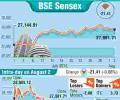
Infrastructure sector grew at 5.2 per cent in June, fastest in two months.

Times have changed, situations have changed, but the basic nature of superpower geo-politics remains the same and so also India's diplomacy -- call it non-alignment, strategic autonomy or neutrality; it all depends on the time scale, notes Rup Narayan Das.

Lump sum investments in equity and hybrid schemes of mutual funds (MFs) declined to Rs 17,900 crore in October - the lowest since January 2021. The fall in lump sum investments comes even as flows through systematic investment plans (SIPs) rose to a new all-time high of Rs 13,000 crore in October. The latest lump sum tally is just a third of the peak inflow of Rs 49,700 crore in July 2021.

If your fund's expense ratio has risen dramatically after Sebi's recent changes, compare it with the category average before switching.

Omkeshwar Singh, head, Rank MF, a mutual fund investment platform, answers your queries.
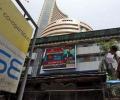
Shares of Avenue Supermarts (DMart) have rallied 15 per cent in the past month, even as the benchmark National Stock Exchange Nifty has remained flat. The stock has garnered favourable commentary from both fundamental and technical analysts after three years of poor performance. "DMart has reached its first 52-week high since October 2021, taking off from solid base formations.

Global funds have pumped in over Rs 38,000 crore (about $5.5 billion) into domestic equities since February 20, helping the Sensex rebound 2,671 points, or 7.6 per cent, from its 2019 low.

Ajit Mishra will answer Your Questions on the stock markets on a weekly basis. Please mail your questions to getahead@rediff.co.in with the subject line 'Stock Market Query' along with your name and Ajit will offer his unbiased views.

Market benchmark BSE Sensex rallied 635 points to 59,942 in the opening trade of the special Muhurat session on Monday to mark the beginning of Hindu Samvat year 2079. The 30-share index was trading higher by 635.12 points, or 1.07 per cent, at 59,942.27 in the first few minutes of trade. Similarly, the broader NSE Nifty surged 192.20 points or 1.09 per cent to 17,768.50.
These stocks offer the best combination of maximum 'buy' recommendations from brokerages and share price upside over the next 12 months.

The Indian equity market is likely to remain under pressure and rangebound over the next few months. This comes as global central banks, led by the US Federal Reserve look at a possibility of hiking rates aggressively to tame inflation. Back home, the Reserve Bank of India, too, remains data dependent in its endeavour to keep inflation in check and pursue an aggressive monetary policy stance.

EM asset classes could rally if the pace of US Federal Reserve rate increases moderates.
 © 2026 Rediff.com - Advertise with us - Disclaimer - Privacy Policy - Sitemap - Feedback - About us - Terms of use - Grievances